
City walk · City history · Churches & faith
The Historic Centre of Irkutsk
From the Moscow Gate to the White House: three centuries in one walk
Photo: Aleksandr Zykov from Russia, CC BY-SA 2.0
- Duration
- 3–4 h
- Distance
- ≈ 3.9 kmcalculated on the OpenStreetMap footpath network
- Difficulty
- Easy
- Best season
- All year
- Getting around
- On foot
- Start
- The Moscow Triumphal Gate, Nizhnyaya Naberezhnaya
- Finish
- The White House (Sibiryakov mansion), Gagarin Boulevard
This route crosses the site of the 1661 stockade and follows the Angara down to the merchant high street. In three to four hours you will see the city’s oldest stone building, a baroque cathedral, a neo-Gothic church, the main square and the mansion of the governors-general.
About this route
Irkutsk began on the high right bank of the Angara where the little Ushakovka river flows in. The stockade has long gone, but the Church of the Saviour still stands on its site, next to the Epiphany Cathedral and a square that has been renamed more than ten times in three hundred years. The route then heads south along Karl Marx Street — Bolshaya, the “high street”, in the nineteenth century — and ends on the upper embankment by the monument to Alexander III.
Almost the whole route is on level pavements. Churches and museums have their own etiquette: in Orthodox churches women usually cover their heads and men remove hats.
The interactive map is unavailable — below is a sketch of the route and the full written itinerary.
The route line was calculated on the OpenStreetMap footpath network and has not been checked on the ground by our editors. The map mirrors the list of stops below; all information is available without the map.
Step-by-step itinerary
-
Stop 1 · Time here: 15 min
The Moscow Triumphal Gate
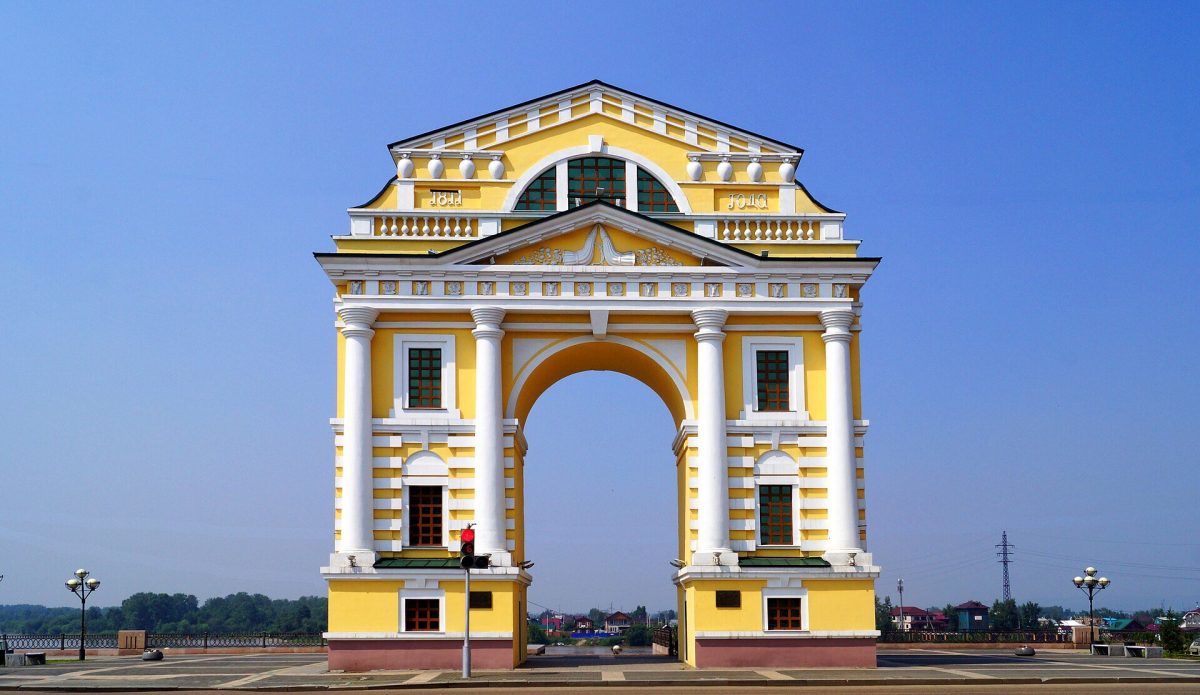 Photo: Putnik.m54, CC BY-SA 4.0
The gate was built in 1811–1813 to mark the tenth anniversary of Alexander I’s reign: the road to Moscow began here, and travellers entered the city from the Angara crossing. It was dismantled in 1928 and rebuilt near its original site in 2011 for the city’s 350th anniversary.
What to look for
The proportions of the classical arch, and the view west along the embankment towards the Epiphany Cathedral.
Tip
A good morning start: with the sun behind you, the embankment and the cathedral are lit.
Open in maps: OpenStreetMap · Yandex Maps · 2GIS -
Stop 2 · Time here: 25 min
The Epiphany Cathedral
Getting there. 300 m west along the lower embankment.
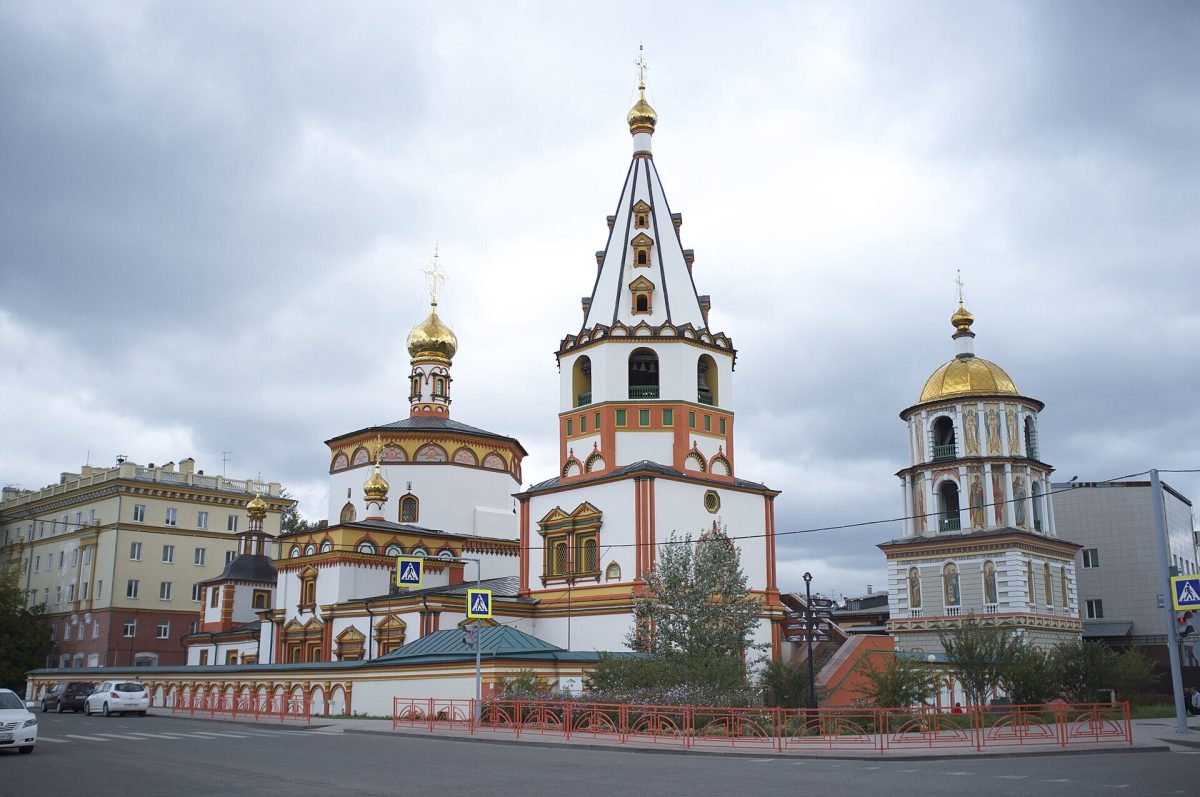 Photo: Aleksandr Zykov from Russia, CC BY-SA 2.0
The stone cathedral was begun in 1718 after an earlier wooden church burned down. Its decoration — glazed tiles, window surrounds and bright paintwork — shows how Siberian craftsmen reinterpreted Moscow and Ukrainian baroque. Its tall tented bell tower can be seen from almost anywhere in the old town.
What to look for
The inset ceramic tiles on the facades, and the contrast between the tented bell tower and the baroque body of the church.
Opening hours & tickets: A working church; check service times and visitor access on site.
Open in maps: OpenStreetMap · Yandex Maps · 2GIS -
Stop 3 · Time here: 15 min
The Polish Church
Getting there. Across the garden south of the cathedral, about 150 m.
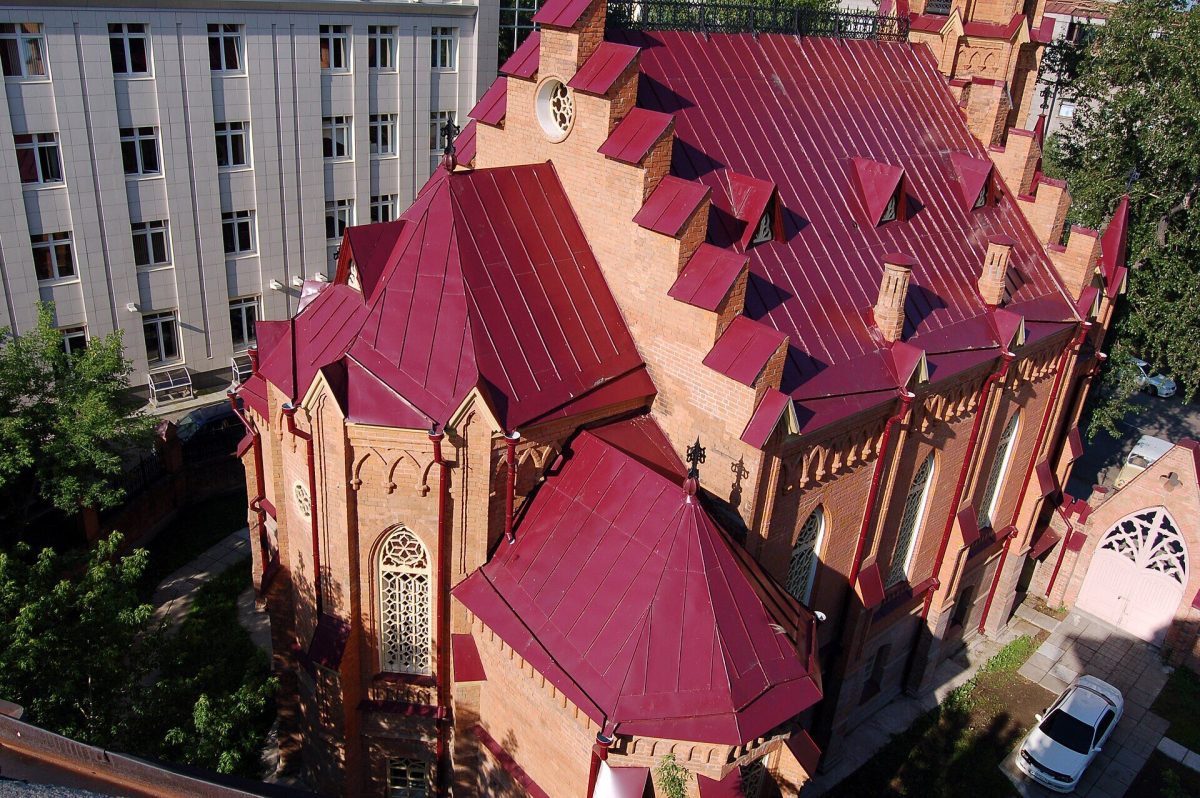 Photo: Yuri Getanov, CC BY 3.0
The neo-Gothic Church of the Assumption was built in the 1880s with money from the Polish community — many of them exiles from the Polish uprisings. The Catholic parish has long since moved to a new cathedral, and the building now serves as the Philharmonic’s organ hall.
What to look for
Red brick, lancet windows and a spire — architecture you hardly expect to find in Siberia.
Tip
If you get the chance, go to an organ concert: the hall’s acoustics are excellent.
Open in maps: OpenStreetMap · Yandex Maps · 2GIS -
Stop 4 · Time here: 20 min
The Church of the Saviour
Getting there. 100 m north-west, on the rise by the embankment.
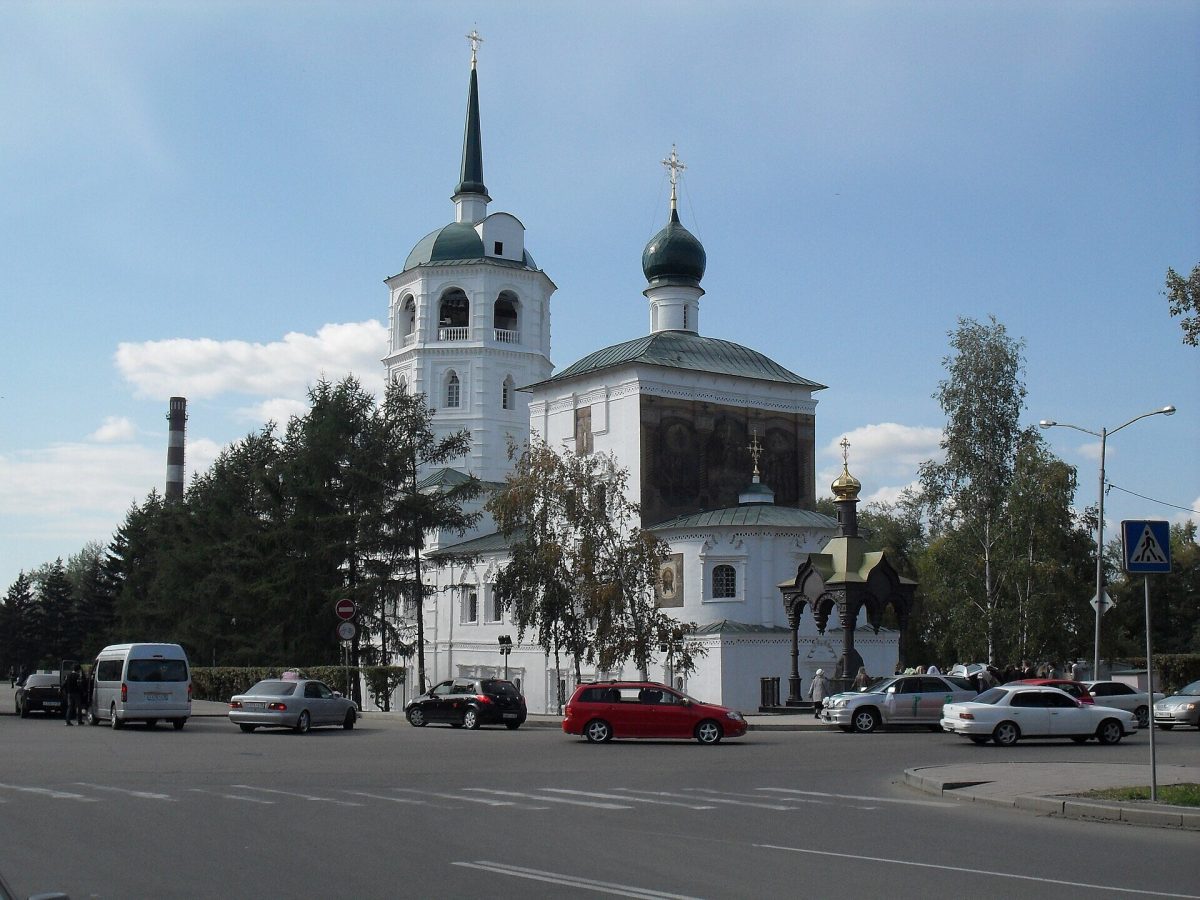 Photo: Fanzuga, Public domain
The Church of the Saviour was built in 1706–1710 inside the old stockade and is the oldest surviving stone building in Irkutsk. Fragments of eighteenth-century painting survive on its exterior — a rarity in Siberia, where almost no external murals have come down to us.
What to look for
The painting on the east wall, and the traces of rebuilding in the brickwork of the bell tower.
Opening hours & tickets: The church’s status and visitor access change — check on site.
Open in maps: OpenStreetMap · Yandex Maps · 2GIS -
Stop 5 · Time here: 10 min
The Eternal Flame and the Lower Embankment
Getting there. Walk down from the Church of the Saviour to the embankment, about 100 m.
The memorial to those who died in the Second World War stands at one of the best viewpoints over the Angara. The river is several hundred metres wide in Irkutsk, and flows so fast that it does not freeze here in winter.
What to look for
The colour of the water: the Angara flows out of Baikal and stays clear and green.
Open in maps: OpenStreetMap · Yandex Maps · 2GIS -
Stop 6 · Time here: 20 min
Kirov Square and Speransky Square
Getting there. 350 m south across Sukhe-Batora Street.
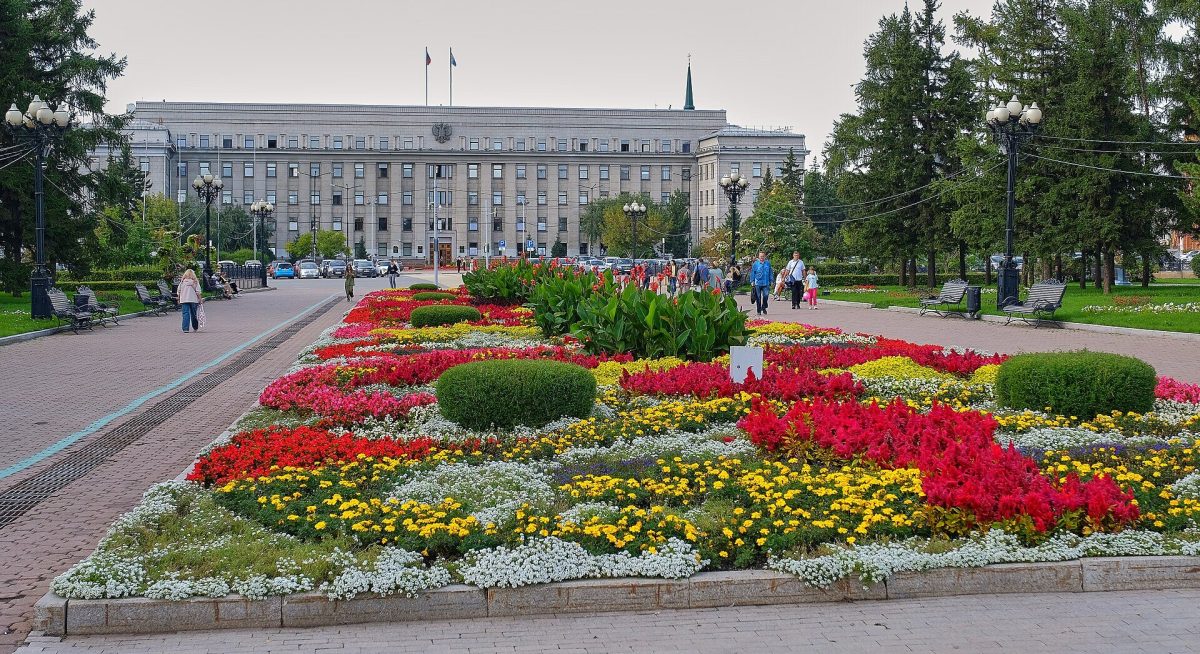 Photo: Vyacheslav Bukharov, CC BY-SA 4.0
The city’s main square has changed its name more than ten times. Until the 1930s the vast Kazan Cathedral stood here; it was blown up in 1932, and the building that now houses the regional government later rose in its place. In 2016 the northern part of the square was named after Count Speransky, the reformer who served as governor-general of Siberia; the park kept the name of Kirov.
What to look for
The open space at the heart of the square — its size gives a sense of the vanished cathedral.
Open in maps: OpenStreetMap · Yandex Maps · 2GIS -
Stop 7 · Time here: 40 min
Karl Marx Street (Bolshaya)
Getting there. East along Lenina Street to Karl Marx Street, then south along it.
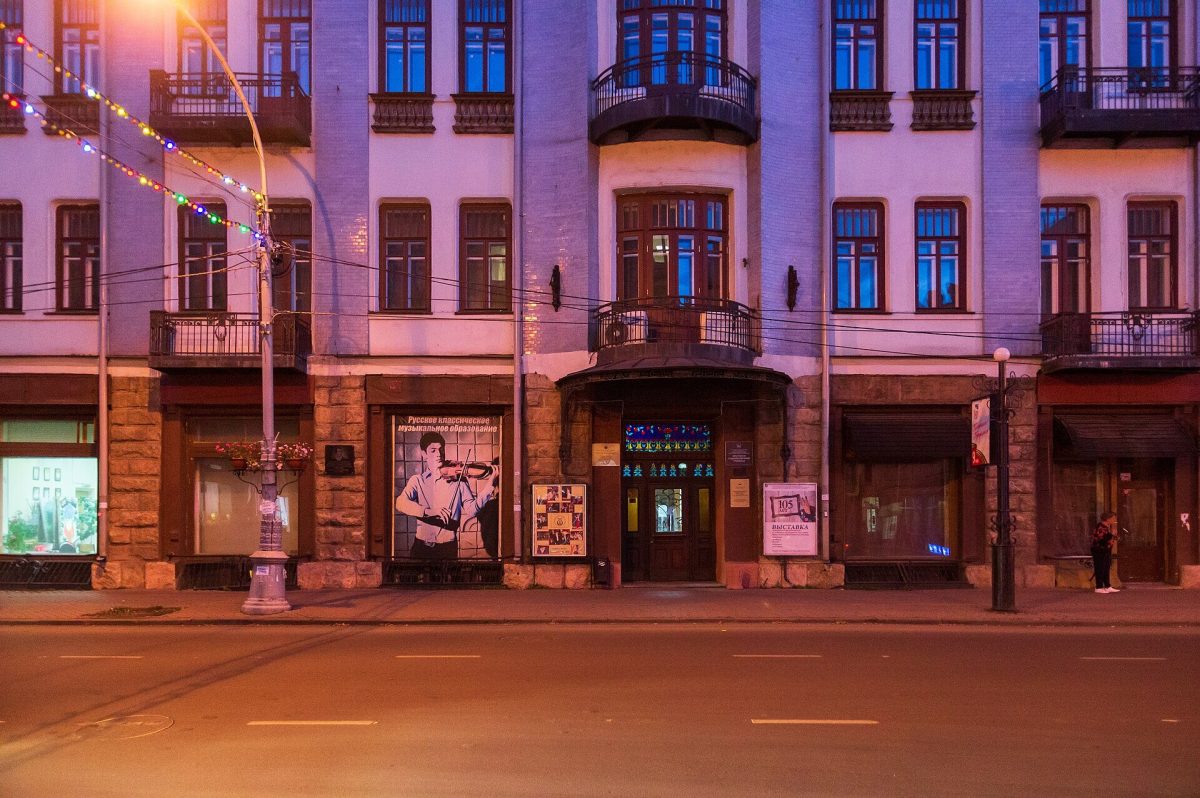 Photo: Vyacheslav Argenberg, CC BY 4.0
The former Bolshaya (“Great”) Street was the main shopping street of pre-revolutionary Irkutsk. After the great fire of 1879 destroyed much of the centre, merchants rebuilt it with stone apartment houses, banks and shops with elaborate facades. Buildings put up over several decades add up to a remarkably coherent street.
What to look for
Stucco, wrought-iron balconies and dates on the facades — look up above the shop windows.
Tip
Walk this part again in the evening, when the facades are lit.
Open in maps: OpenStreetMap · Yandex Maps · 2GIS (approximate location) -
Stop 8 · Time here: 20 min
The Museum of Local Lore building
Getting there. At the end of Karl Marx Street, beside Gagarin Boulevard.
This brick building was put up in the 1880s for the East Siberian branch of the Russian Geographical Society, after the previous museum was lost in the fire of 1879. The facade carries the names of explorers of Siberia and Central Asia. Many of the scientists who worked here were political exiles.
What to look for
The names on the frieze — see if you can find Chersky and Przhevalsky.
Opening hours & tickets: Whether the galleries in this building are open, and their hours, should be checked with the museum.
Open in maps: OpenStreetMap · Yandex Maps · 2GIS (approximate location) -
Stop 9 · Time here: 10 min
The Alexander III monument
Getting there. Across the road on Gagarin Boulevard.
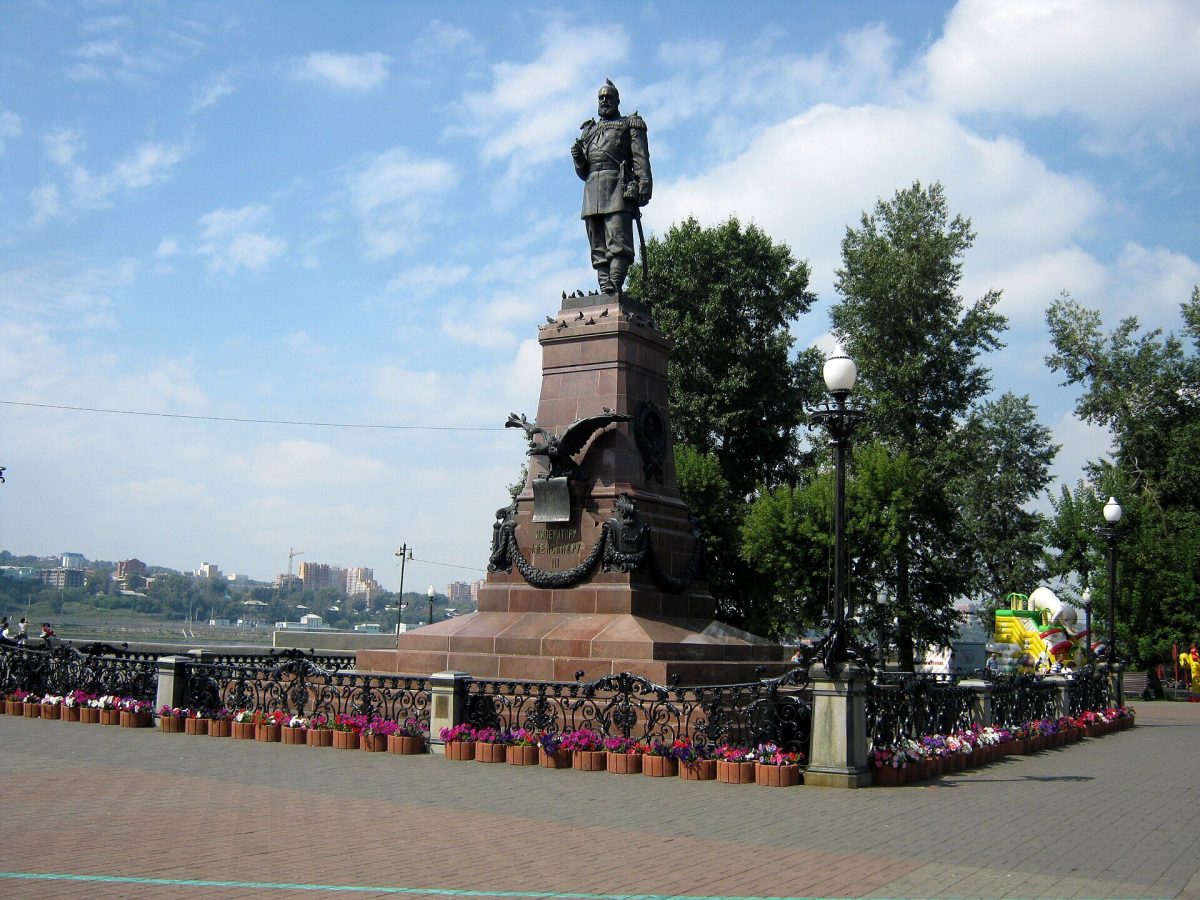 Photo: Георгий Долгопский, CC BY-SA 4.0
The monument was unveiled in 1908 to commemorate the building of the Trans-Siberian Railway; the sculptor was Robert Bach. After the revolution the emperor’s figure was removed and the pedestal stood for decades with a different top. The bronze figure was recreated in 2003.
What to look for
The reliefs on the pedestal with portraits of Muravyov-Amursky, Speransky and Yermak.
Open in maps: OpenStreetMap · Yandex Maps · 2GIS -
Stop 10 · Time here: 10 min
The White House (Sibiryakov mansion)
Getting there. A few steps north of the monument.
The merchant Sibiryakov’s mansion was built in the very early nineteenth century in the classical style. The governors-general of Eastern Siberia later lived here, Nikolai Muravyov-Amursky among them. Today the White House holds the research library of Irkutsk State University.
What to look for
The colonnade, and the way the mansion commands the corner above the river.
Open in maps: OpenStreetMap · Yandex Maps · 2GIS
 Photo:
 Photo:
Practical tips
Transport
The start is a 10–15 minute walk from Kirov Square, which is served by many buses and trams (stop “Skver im. Kirova”). From the finish on Gagarin Boulevard it is a 10-minute walk back to the centre along Lenina or Karl Marx Street.
Practical tips
- Go in the morning, when the light falls on the cathedral and the Church of the Saviour.
- Allow an extra hour if you want to visit the Museum of Local Lore.
- You will find cafés along Karl Marx Street and around Kirov Square.
Seasonal notes
The route works in every season. In winter daylight is short and pavements are icy — start around midday. In summer Kirov Square, with its flower beds and fountain, is at its best.
Accessibility
The route is almost entirely on asphalt and paving with no steep climbs. A gentle slope leads from the cathedral down to the lower embankment; most churches have steps at the entrance.
Safety and caring for nature
Cross Nizhnyaya Naberezhnaya only at pedestrian crossings — traffic here is fast. Pavements are slippery in winter.
Budget
The walk is free; you pay only for any museums you choose to visit.
Photographs
 Photo: Putnik.m54, CC BY-SA 4.0
 Photo: Fanzuga, Public domain
 Photo: Vyacheslav Bukharov, CC BY-SA 4.0
 Photo: Георгий Долгопский, CC BY-SA 4.0
Destinations: Irkutsk
Related routes

Churches, Monasteries and Religious Architecture
Siberian baroque, neo-Gothic, a synagogue and a mosque — a city of many faiths
View itinerary: Churches, Monasteries and Religious Architecture
The Angara Embankment
Along the only river that flows out of Lake Baikal
View itinerary: The Angara EmbankmentA One-Day Introduction to Irkutsk
The essentials, from the cathedral to sunset over the Angara
View itinerary: A One-Day Introduction to IrkutskRead before you go
History of Irkutsk 2 min read
From Stockade to Capital of Eastern Siberia: a Short History of Irkutsk
Irkutsk was founded in 1661 as a stockade on the Angara. In three and a half centuries it has been a trading gateway to China, the capital of a vast governorship, a…