
Irkutsk was founded in 1661 as a stockade on the Angara. In three and a half centuries it has been a trading gateway to China, the capital of a vast governorship, a place of exile and a university city. A brief guide to its eras — and where to see them today.
A stockade on the high bank
In 1661 a band of Cossacks built winter quarters, and then a stockade, on the right bank of the Angara opposite the mouth of the Irkut — which gave the town its name. The site was well chosen: the high bank was safe from floods, and the rivers linked it to Lake Baikal and to the Siberian routes west. Irkutsk received town status in 1686.
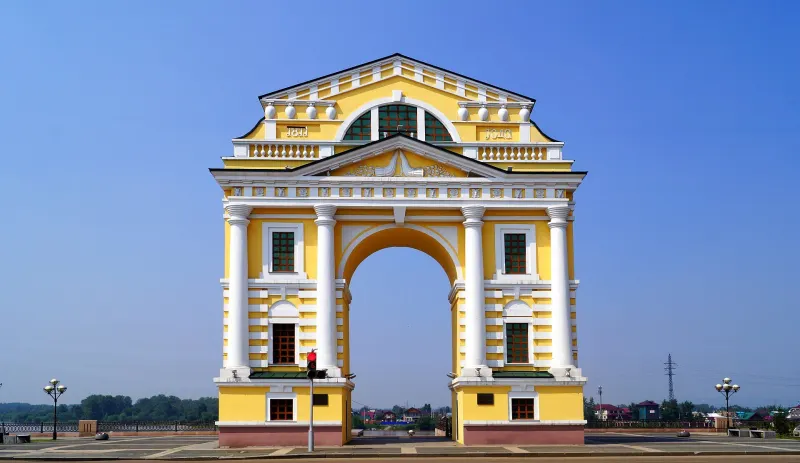
Nothing remains of the wooden stockade, but its site is easy to find: the ground around the Church of the Saviour (1706–1710) and the Epiphany Cathedral, by the Moscow Gate on the lower embankment.
A merchant city
In the eighteenth century Irkutsk sat on the main road of the China trade: tea, silk and cloth came in through Kyakhta, furs went out. Irkutsk merchants grew rich and built — the stone churches of the eighteenth century were largely paid for by their donations. Expeditions to the Pacific and to America were fitted out here too: Grigory Shelikhov, founder of the first Russian settlements in Alaska, is buried at the Znamensky Convent.
Capital of Eastern Siberia
In 1822, following Mikhail Speransky’s reforms, Irkutsk became the seat of the Governor-General of Eastern Siberia — the administrative capital of a territory stretching from the Yenisei to the Pacific. The governors-general lived in the merchant Sibiryakov’s mansion on the Angara, known today as the White House. The most famous of them, Nikolai Muravyov-Amursky, directed Russia’s annexation of the Amur region from here.
Exile that became culture
After the uprising of 1825 the Decembrists were sent to Siberia. In the 1840s several families, including the Volkonskys and Trubetskoys, were allowed to settle in Irkutsk. Their homes became centres of music, education and society. Later, exiles from the Polish uprisings arrived; some of them — Czerski, Czekanowski, Dybowski — became the leading explorers of Siberia and Lake Baikal.
“Irkutsk is a splendid town. Thoroughly cultured.”
Anton Chekhov, letter to his family, 1890
The fire of 1879
In the summer of 1879 a great fire destroyed much of the wooden centre, including the Geographical Society’s museum and archive. The centre was rebuilt in stone — hence the apartment houses and banks of Bolshaya Street (today Karl Marx Street). Wooden houses survived in the suburbs, which is why whole streets of them can still be seen in Irkutsk today.
The twentieth century
The Trans-Siberian Railway reached Irkutsk in 1898. The university opened in 1918. The Civil War left its mark: Admiral Kolchak was executed here in February 1920. In the 1950s the Irkutsk hydroelectric dam raised the level of Baikal and changed the Angara in the city, which no longer freezes in winter. For the city’s 350th anniversary in 2011, the Moscow Gate was rebuilt and the 130th Quarter opened.
Where to see the history
- The stockade and the eighteenth century — the Church of the Saviour, the Epiphany Cathedral, the Znamensky Convent.
- The governors-general — the White House and the Alexander III monument on Gagarin Boulevard.
- The Decembrists — the Volkonsky and Trubetskoy house museums.
- Merchant Irkutsk — Karl Marx Street and the wooden neighbourhoods.


