
The wooden houses of Irkutsk are not decoration but a language in which owners told passers-by about themselves. This short glossary will help you tell relief carving from fretwork, see how a log house is jointed, and understand why so many windows almost touch the pavement.
Irkutsk is one of the few large Russian cities where nineteenth- and early twentieth-century wooden houses survive in whole neighbourhoods. A few words of vocabulary make walking among them far more rewarding.
The log frame: two ways to join a corner
A house begins as a frame of logs. Look at the corners. If the log ends stick out, the corner is joined v oblo, “with a remainder” — a strong, warm way to build. If the corner is flush, with no ends showing, it is joined v lapu, “in the paw” — which allowed the house to be clad in boards so that the facade looked like stone. Many town houses are clad and painted; you only see the logs at the corners and near the foundations.
Window frames and shutters
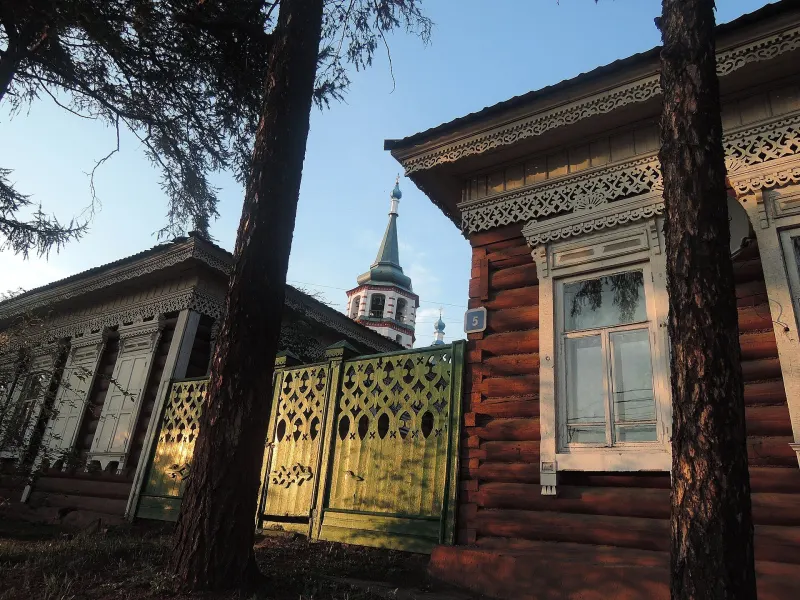
The nalichnik, the carved surround of a window, is a house’s chief ornament and its owner’s calling card: the richer the pattern, the richer the household. Shutters kept out cold and curious eyes, and were often painted in contrasting colours — green, blue or ochre.
Relief carving and fretwork
- Relief carving is cut into the surface of the board, leaving a background. It decorates older houses.
- Fretwork is sawn right through, so you see the wall or sky behind it. It became fashionable at the end of the nineteenth century and turned facades into “lace” — the best example is the Lace House on Friedrich Engels Street.
Eaves boards, cornices and gables
The podzor is a carved board hanging below the edge of the roof, like a fringe. Cornices and gables often repeat the motifs of the window frames, pulling the facade into one composition. Look at corner houses: they were decorated more lavishly because they could be seen from two streets.
Why the windows are at ground level
Many houses seem to have sunk into the ground, their ground-floor windows almost level with the pavement. It is less that the houses sank than that the ground rose: over a century and a half, layers of debris and road surfacing have built up by tens of centimetres. It is one of the clearest signs of a house’s age.
Looking with care
Morning and evening are the best times to read the houses: low light brings out the relief. Snow makes the patterns sharper in winter; in summer leaves sometimes hide the facades.


