
Lake Baikal was the greatest obstacle on the route of the Trans-Siberian Railway. First, trains were ferried across on an icebreaker; once, rails were laid across the ice itself; and finally a line was built along the rocky shore that is still regarded as an engineering masterpiece.
A lake across the line
When the Trans-Siberian was built in the 1890s, the line advanced quickly west and east of Baikal. But the lake’s southern shore is a wall of cliffs dropping straight into the water. Building there was difficult and expensive, so at first the plan was to cross the lake instead.
The icebreaker-ferry Baikal
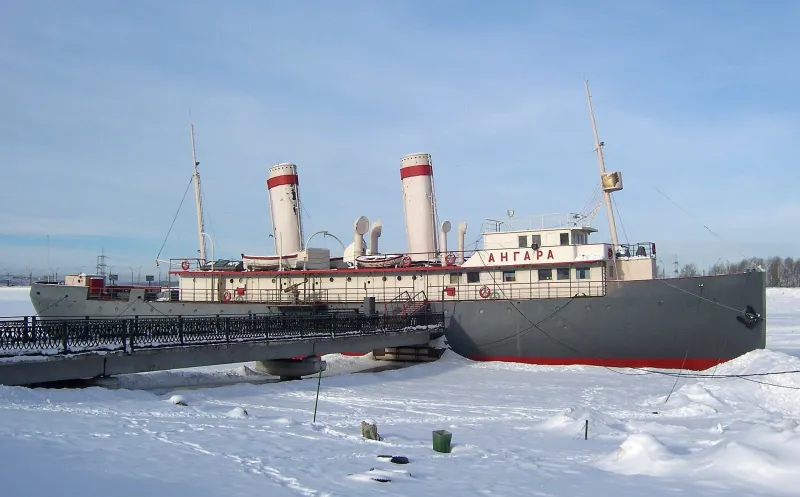
A large icebreaker-ferry, the Baikal, able to carry railway wagons, was ordered from England, along with a smaller icebreaker, the Angara, for passengers and freight. The ships were delivered in pieces and assembled on the shore at Listvyanka. From the early 1900s they sailed between Port Baikal and Mysovaya station on the eastern shore.
Rails across the ice
In winter the ice defeated even the icebreakers. At the start of the Russo-Japanese War in 1904, when moving troops east became urgent, rails were laid directly across the frozen lake and wagons were hauled over them. The episode became one of the legends of the Trans-Siberian.
A railway in the cliffs
Meanwhile a railway was being built along the south-western shore from Port Baikal to Kultuk. Along some 89 kilometres, engineers had to drive dozens of tunnels and build stone galleries to protect the track from rockfall, along with hundreds of bridges, culverts and retaining walls. Regular traffic began in the mid-1900s and the Trans-Siberian became continuous. For its difficulty and beauty, the line is called “the golden buckle on Russia’s steel belt”.
Every tunnel here is a separate stone structure with its own number and its own portal. You can read the Circum-Baikal like a book.
How the main line moved into the mountains
In the 1950s the Irkutsk dam raised the Angara, flooding the riverside section from Irkutsk to Port Baikal. By then the Trans-Siberian main line had already been moved to a new route over the mountains from Irkutsk to Slyudyanka. The Circum-Baikal became a dead-end branch — which is exactly why it survives almost untouched.
The Circum-Baikal today
Today suburban trains, known by various nicknames, run along the line alongside tourist trains with guided programmes. Many visitors walk part of the way. The railway is a monument of history and engineering, set within Pribaikalsky National Park.


