
Baikal is described in superlatives: the deepest lake on Earth, one of the oldest, holding about a fifth of the planet’s unfrozen surface fresh water. Here is what lies behind those numbers — and how they shape what you will see from the shore.
Depth and age
Baikal’s greatest depth is about 1,640 metres, making it the deepest lake on Earth. It lies in a rift — a place where the Earth’s crust is slowly pulling apart. The lake is estimated to be 25 to 30 million years old, one of the oldest on the planet. The rift is still active, which is why earthquakes are not unusual in the region.
A fifth of the world’s fresh water
Baikal holds roughly 23,000 cubic kilometres of water — about a fifth of all the liquid fresh water on the Earth’s surface. More than three hundred rivers and streams flow in; just one, the Angara, flows out.
Clarity
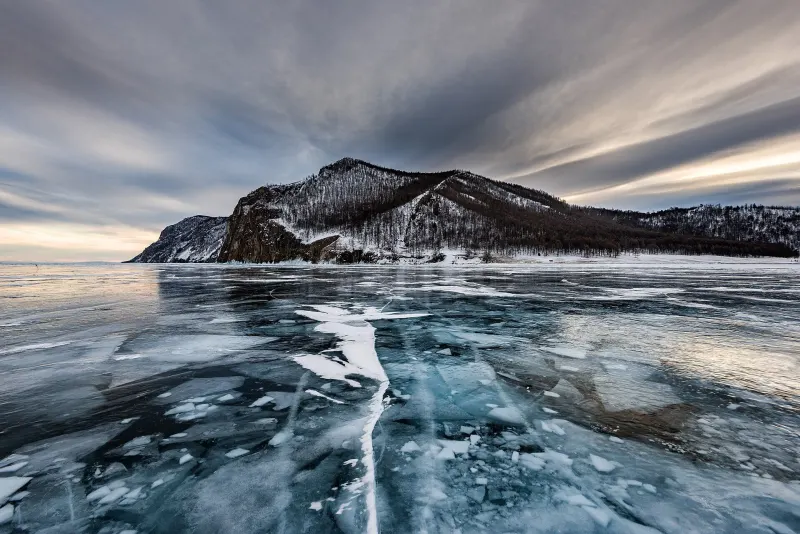
In spring, after the ice breaks up, Baikal’s water is especially clear: you can see the bottom tens of metres down. The reasons are low sediment and the work of a tiny crustacean, the epishura, which filters the water. In winter the ice is clear too: with little snow and strong winds it stays smooth and dark, like glass.
Life found nowhere else
Long isolation turned Baikal into a laboratory of evolution: a large share of its species are endemic — found nowhere else. Among them:
- the Baikal seal, or nerpa — a freshwater seal;
- omul — a fish of the salmon family and the emblem of Baikal cuisine;
- golomyanka — a translucent fish that gives birth to live young and lives at great depths;
- epishura — the crustacean without which the water would not be so clean.
Lake Baikal was inscribed on the UNESCO World Heritage List in 1996.
What this means for travellers
- The water is cold. Such a vast volume warms slowly: even in August a swim off the open shore is bracing. The shallow bays of the Maloye More are warmer.
- The weather changes fast. The lake makes its own climate and winds — the sarma, the kultuk, the barguzin. Bring warm layers in any season.
- The shore is fragile. Do not wash with soap in the lake, take your litter home, and only light fires where it is allowed.
Baikal does not need superlatives. Stand at the source of the Angara and watch the clear water leave the lake for the river.


